About 60,000 migrants arrive in Ceuta in 24 hours, Spanish territory's leader says
The estimated number of arrivals is more than 70% of the population of the city, which is about 83,600.
About 60,000 migrants have crossed into Spain's North African territory of Ceuta from Morocco in the last 24 hours, Ceuta's president says.
At least 34 people have died during the crossing, Juan Jesús Vivas said during a news conference.
The influx comes after Spain's Supreme Court ruled this month that migrants stopped at sea while trying to reach Ceuta or Melilla, another Spanish exclave, cannot be summarily returned to Morocco.
Prime Minister Pedro Sánchez described the situation as an "attack" and said the government was working to return all illegal migrants to Morocco "as soon as possible". Several European leaders have expressed concern, some promising to tighten border controls.
Spain sending troops as thousands enter enclave of Ceuta from Morocco
UK Prime Minister Andy Burnham and the French president offered to help Spain.
Ceuta, on Morocco's northern coast, is separated from mainland Spain by the Strait of Gibraltar and has long been a focal point for migrants attempting to reach Europe.
Local officials had appealed to Madrid for help after a recent rise in attempted crossings, but there were chaotic scenes on Thursday as border controls apparently broke down.
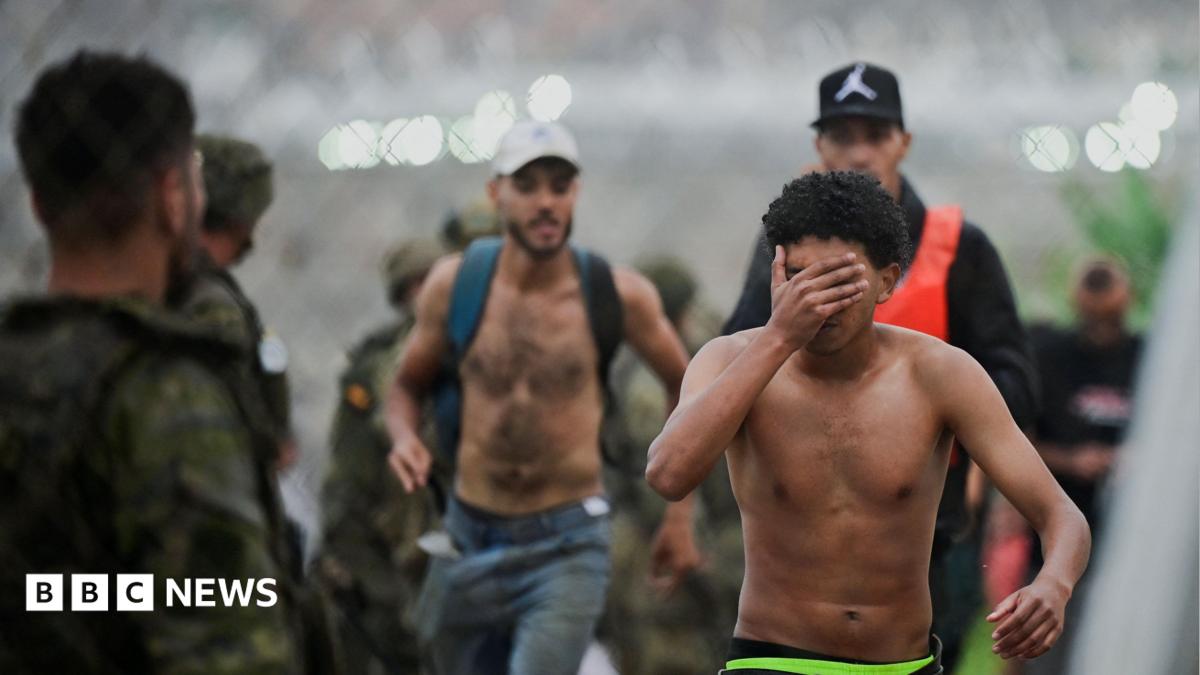
Videos and images from Thursday show thousands of people swimming into the city, while local media reported crossings continuing into Friday.
Jesús Vivas said the situation was "unsustainable" and that the recent arrivals amounted to around 70% of the city's population - which sits at around 83,600 according to the latest local figures.
Spain has now deployed its armed forces to bolster security in Ceuta and at its sister city of Melilla, where between 300 to 400 crossings were also reported overnight.
Speaking on Friday during a visit to Ceuta, the prime minister condemned the crossings and said it was an attack on Spain's territorial integrity.
Sánchez added that the government would be looking at reinforcing the border with Morocco.
The prime minister blamed the dangerous events on criminal networks manipulating the Supreme Court's recent ruling, adding that incorrect information had "spread like wildfire in recent hours".
He said authorities in Morocco were co-operating with plans to return those who had entered illegally.
Ceuta and Melilla trace their Spanish past to the 15th Century, and they have enjoyed a limited degree of self-government since 1995.
Coveted by Morocco, they have long been a flashpoint in diplomatic relations between the two countries.
They form the European Union's only land borders with Africa.
Many of those crossing the border from Morocco have been young, mainly men, although there are also women and children in the crowds and even babies.
Officials estimate at least 7,000 of those who crossed illegally into the territory in the last 24 hours are minors.
Usually, to try to enter Ceuta, migrants swim several kilometres from further up the coast. This time they appear to have been able to get close to the border fence itself with ease. At the start, some even walked along the rocks on the jetty and around the end of it, but most had to swim out and around to reach the beaches on the other side.
It's not clear where the Moroccan border guards were at this point and why the groups of migrants were not dispersed or stopped.
One migrant told Reuters news agency that he was returning to Morocco, adding:
"It's not good at all, and it's not fun either.
"I mean, people are dying here. I beg you, please, if you haven't come yet, don't come. Don't do it."
Local media reported chaos on the streets of Ceuta since Thursday, with one resident telling Spain's ABC that people were scared.
"Nobody is going out on the street. They're afraid.
"This is stronger and more aggressive than what we've experienced before," a hospital security guard told the Spanish site.
The last time there was a surge in arrivals - though on nowhere near this scale - was in 2021. At that point, the Moroccan authorities allowed some 8,000 people to cross the border following a dispute with Madrid over the sovereignty of the Western Sahara.
That diplomatic dispute has flared again recently, after Sánchez travelled to Algeria which backs independence for the region.
Italy's right-wing Prime Minister Giorgia Meloni was very quick to comment on events in Ceuta, calling the images from there "shocking" and writing on social media that such "uncontrolled immigration" was a security threat to Europe.
She said Italy would consider suspending the Schengen zone agreement with Spain on free movement, although it's unclear what that means in practice given that the two countries are not neighbours and undocumented migrants are unlikely to board flights.


