Critical former referees add to culture of fear, says retiring Taylor
Retiring Premier League referee Anthony Taylor says his decision to quit was partly due to the toxic debate around officials.
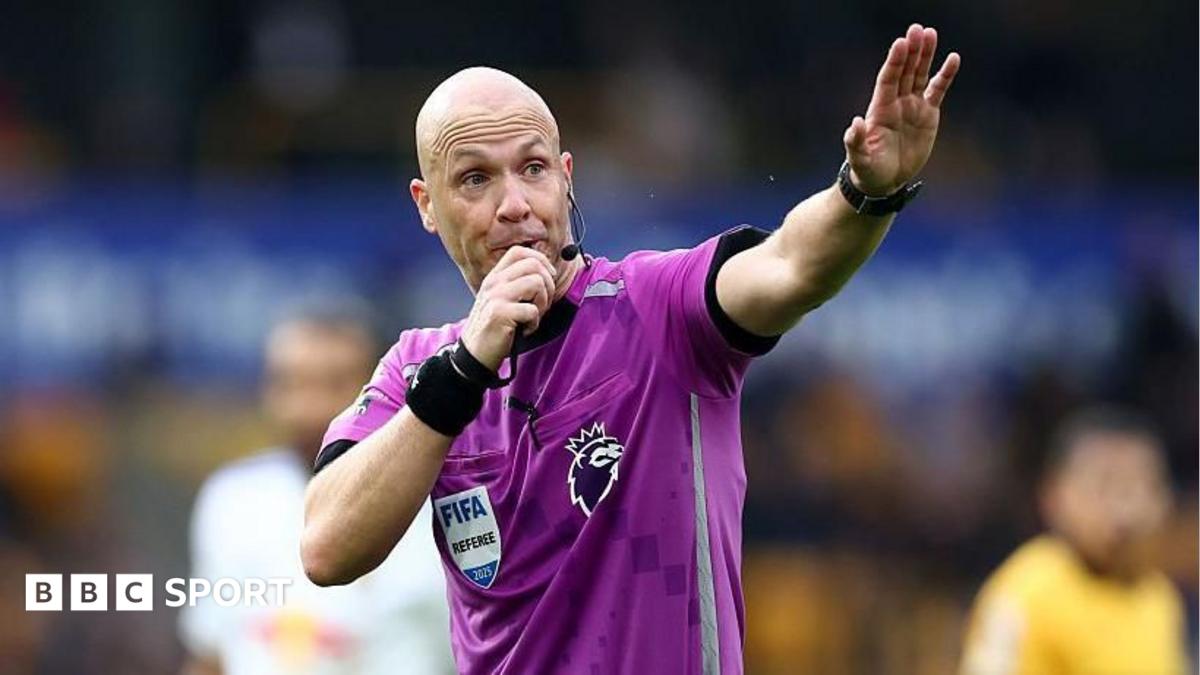
Just five weeks ago, Anthony Taylor was centre stage at the World Cup - refereeing the last-16 match between Spain and Portugal in Dallas.
But now, for the first time in 20 years, he is not involved as an English football season gets under way.
From the outside, the turnaround from officiating at the highest level to retirement seems sudden.
Here, for the first time, the 47-year-old explains his decision in detail - opening up on the impact of the often toxic debate surrounding officiating, and the intense scrutiny faced by referees.
Taylor also says he thinks his fellow officials should think twice before criticising their former colleagues in the media and talks of his hopes of helping Turkish football emerge from a sprawling referee betting scandal.
And he reveals what he really thinks of the video assistant referee (VAR) system.
Football Daily - Taylor on retirement, career and scrutiny on referees
'Any referee will be lying if they said pressure or scrutiny does not bother them'
Taylor retired last month, announcing in a short statement the end of a career during which he officiated 668 matches in the English professional game, every major domestic cup final, and 163 international fixtures.
He wrote it had been "an immense privilege, but the pressure is intense and the scrutiny is constant".
"It was part of it," Taylor says when we meet at his lawyer's offices in Leeds.
"Any referee will be lying to you if they said that pressure or that scrutiny did not bother them, because that's a natural human reaction.
"One of the challenges that referees face at every level is actually understanding the challenges that we face.
"Fear of making mistakes, external opinion, spectators, managers, parents, media, colleagues. All these things feed into creating self-doubt, lacking confidence, and then things can spiral out of control and you lose the ability to actually have any confidence in what you're doing on the field."
For years, Taylor said he had developed "resilience" to handle the pressures he faced, but can that only last so long?
"Everybody will experience times where dealing with that environment for a long period of time, your energy levels would dip," he says.
"That then starts to impact on motivation and your actual confidence. It goes back to the confidence again of, 'I've got to go again, make sure I don't make a mistake, still want to get to this tournament or have this match'. It's a very real feeling that everybody would go through.
"I was very confident in my own coping mechanisms on how I dealt with that.
"The decision to retire is purely based on my body and my mind coming to its natural course in that current role - and it's ready to go on a new journey."
Needing a break from pressure
Having taken charge of three matches in his second World Cup, Taylor says he only decided to retire once his tournament ended, which seemed like "the perfect time".
He says he has not missed gruelling pre-season training drills, but admits to "a hint of sadness" because "that's a big part of my life that I'm going to miss being involved in".
"I wanted to decide when I finished on my own terms," he says. "And I don't think you can say there's any better place to finish than at the World Cup."
So are his family relieved? Last year, Taylor told BBC Sport they no longer went to his matches because of the abuse he received, and spoke about how they were targeted by Roma fans in Budapest Airport after the 2023 Europa League final.
"Undoubtedly one of the things that you are considering are the serious sacrifices that both your family and your friends have made over the years for you to do what you do," he says.
"Family life takes a back seat… so, for sure, that was a big part of why I decided to step back.
"It was in combination with... the scrutiny and the demands placed on referees at the very top level. And that doesn't necessarily mean that you're struggling to cope with those demands, but it comes to a point where it feels that your body and your mind needs to take a break from those kind of pressures."
Taylor has stayed off social media in recent years, but admits there is a limit to avoiding the scrutiny.
"Even away from social media, the general coverage of football these days is 24/7," he says. "So there's a lot more mediums for you to discover what people think about what happened last weekend.
"It's not always negative feedback when you come across fans and people when you're travelling around the country. But it is like you are living in a goldfish bowl for 10 months of the year."


