Is Bengaluru Livable for the Next Generation
Explore how deep borewell drilling in Bengaluru threatens hard-rock aquifers, drives microclimatic warming, and triggers long-term health and ecological risks.
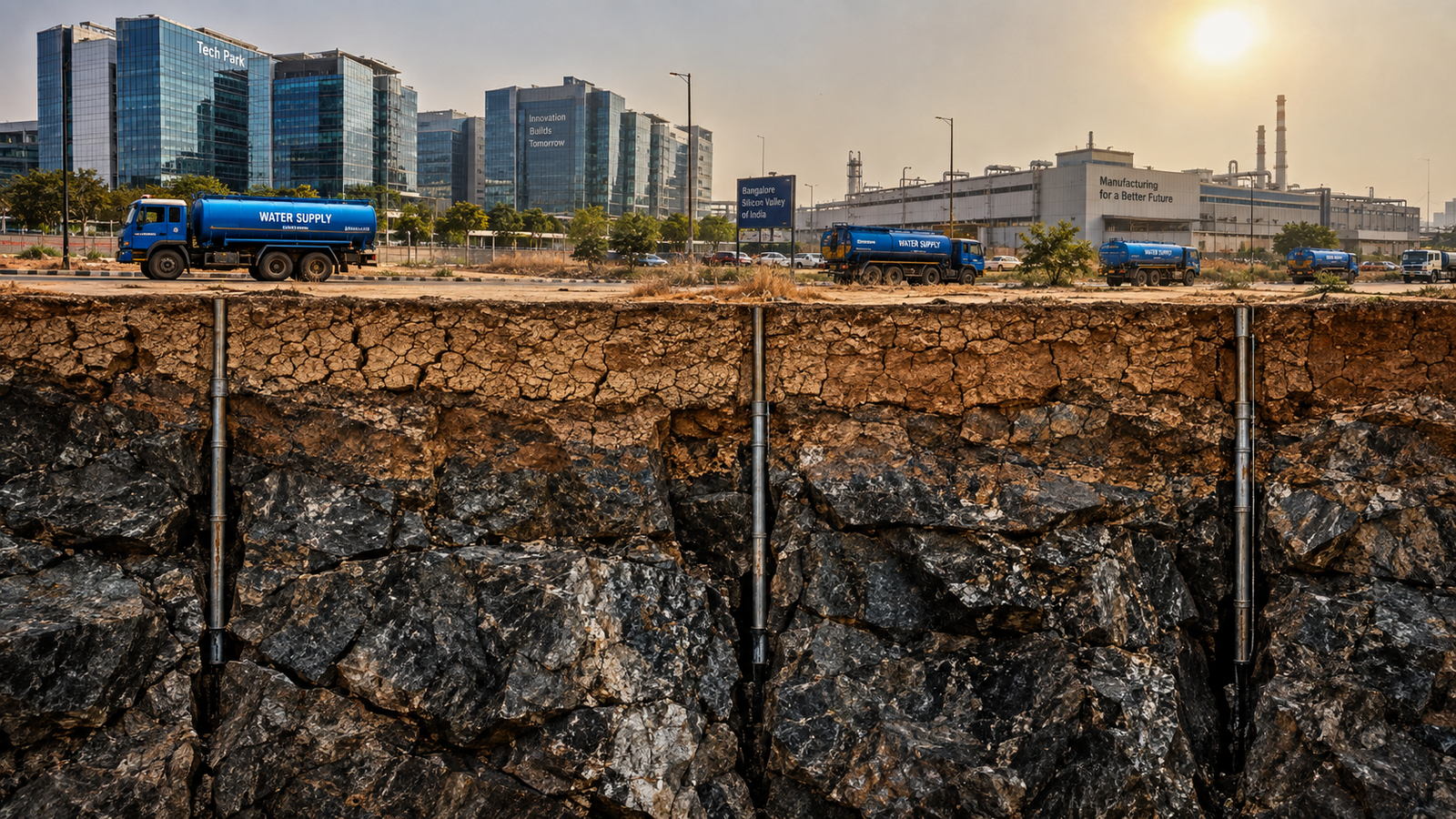
BENGALURU: For decades, India premier technology hub expanded on the assumption that resources would perpetually match ambition. Today, that growth model has collided with a hard hydrogeological limit. Hundreds of feet beneath tech parks, gated communities, and industrial corridors, the subterranean hydrology of Bengaluru is experiencing structural collapse. What public discourse still treats as a seasonal tanker supply gap has escalated into deep aquifer mining, pointing toward an inescapable conclusion: without immediate structural reform, Bangalore is not viable for the next generation.
Civic discussions consistently center on short term palliatives, including tanker price caps, pipeline expansion deadlines, and intermittent supply rationing. Yet hydrogeologists, civil engineers, and environmental scientists warn that pumping ancient water from crystalline bedrock fractures threatens the fundamental habitability of the metropolis within the decade.
The Scale of Industrial Consumption
Assessing water use across the industrial belt requires separating direct assembly operations from the embedded supply chain.
In automotive manufacturing, direct factory intake ranges between 2500 and 4500 litres per passenger car. Modern optimized assembly plants have brought this figure close to 2000 litres. The paint shop accounts for 60 to 70 percent of this in plant demand, dedicated to chemical pre treatments, cathodic electrodeposition baths, and multi stage deionized water rinses. Industrial cooling towers for robotic welding arms, boilers, and high pressure leak testing shower bays consume the remainder.
Upstream supply chains multiply that volume significantly. Accounting for raw material extraction and processing including blast furnace steel production, aluminium smelting, tire vulcanization, synthetic polymers, and silicon semiconductor fabrication, the total cradle to gate water footprint ranges between 25000 and 60000 litres per vehicle. For battery electric vehicles, that figure rises to roughly 80000 litres due to the intensive chemical refining demanded by lithium, nickel, and cobalt.
In the Bidadi industrial corridor southwest of Bengaluru, vehicle manufacturing runs at substantial volume. The Toyota Kirloskar Motor complex, spanning over 432 acres across two assembly plants, maintains an installed annual capacity of roughly 342000 vehicles. Operating across an estimated 300 working days a year, the complex turns out between 1000 and 1140 cars every working day, rolling a finished car off the line every 75 to 80 seconds. While major original equipment manufacturers invest in on site rainwater reservoirs and wastewater treatment, hundreds of unorganized Tier 2 and Tier 3 suppliers across Peenya, Bommasandra, and Bidadi continue to draw heavily on local groundwater.
Commercial Bottling and Aquifer Depletion
Operating alongside heavy manufacturing is the decentralized commercial packaged drinking water sector. Concentrated in peri urban taluks such as Magadi Road, Nelamangala, Anekal, Hoskote, and Devanahalli, bottling plants treat groundwater as an extraction commodity.
Standard industrial reverse osmosis systems in commercial bottling units operate with notable inefficiency, typically recovering only 50 to 65 percent of raw intake. For every 1000 litres of drinking water packaged into retail bottles or 20 litre bubble top cans, between 350 and 500 litres of concentrated mineral reject brine are discarded, regularly flushed into open storm drains or barren ground.
A single mid sized bottling unit extracts between 50000 and 200000 litres of raw groundwater daily. Across hundreds of licensed and unauthorized packaging operations throughout the metropolitan area, tens of millions of litres are drawn every 24 hours. This creates an unsustainable feedback loop: as municipal pipelines and community wells run dry, urban residents buy more canned water, prompting bottling units to sink deeper wells into the same overdrawn aquifers.
The Fragility of Peninsular Geology
The fundamental reason this extraction causes irreversible damage lies in the geological structure of Peninsular India. Unlike northern river basins that rest on deep, sponge like alluvial sediment capable of holding contiguous groundwater reserves, Bengaluru sits on a rigid basement of crystalline granite and gneiss rock.
In hard rock terrain, groundwater does not pool in vast underground lakes. It is stored exclusively within narrow fissures, weathered joints, and secondary faults:
Three decades ago, open dug wells and shallow borewells struck reliable water at depths of 60 to 150 feet. Decades of unmitigated concrete paving and over extraction have completely dried up this upper weathered zone.
Today, industrial rigs and residential borewells routinely drill to depths between 1200 and 1800 feet, with several drilling rigs pushing past 2000 feet. At these depths, submersible pumps draw non replenishable fossil water that took centuries to percolate through dense rock strata. Once emptied, these hard rock fractures cannot recharge over a few monsoon seasons.
Water drawn from such extreme depths under high negative pressure pulls directly from mineralized, deoxygenated rock zones, carrying elevated levels of total dissolved solids, fluorides, nitrates, and heavy minerals.
The Decadal Horizon: An Unviable Urban Core
If high volume extraction continues on its current trajectory without structural changes, hydrogeological models point to severe regional disruption over the coming decade:
1. Drilling in peripheral industrial belts and outer residential layouts will regularly exceed 2000 to 2400 feet, reaching dry, impermeable bedrock where drilling becomes technically impossible.
2. Seasonal borewell failure rates across peripheral settlements are projected to rise from the current 40 percent to more than 80 percent, triggering mass water rationing.
3. Private water tanker operations will face logistical failure as supply points are pushed 40 to 60 kilometres outside the district, escalating hauling costs beyond economic viability.
4. Sustained evacuation of deep subterranean pore water removes structural support from subsoil layers, causing irreversible ground compaction. When monsoon downpours arrive, the compressed ground cannot absorb moisture, turning life giving rainfall into destructive surface runoff and flash floods rather than aquifer recharge.
Halting this crisis demands moving away from unmetered extraction to circular water systems: enforcing mandatory Zero Liquid Discharge across all manufacturing units, freezing commercial packaging permits in over exploited zones, expanding tertiary treated sewage pipelines for industrial cooling, and constructing deep injection recharge systems across every major industrial and commercial layout. Without these immediate interventions, the city risks leaving the next generation with an exhausted landscape and dry taps.


