JEE Advanced 2026: More qualifiers despite slower seat growth; CSE dominates
BTech seats at IITs failed to keep pace, with only about one in three qualifiers eventually securing a seat | India News
BTech seats at IITs failed to keep pace, with only about one in three qualifiers eventually securing a seat
The Joint Entrance Examination – Advanced (JEE–Advanced) qualifiers rose by nearly 5% this year, but the Bachelor of Technology (BTech) seats at 23 Indian Institutes of Technology (IITs) failed to keep pace, with only about one in three successful candidates eventually securing a seat at the premier institutes, according to the Joint Implementation Committee (JIC) report. IIT Roorkee, the organising institute for JEE-Advanced 2026, released the report on Saturday.
As many as 56,880 candidates qualified, compared with 54,378 in 2025, an increase of 2,502 or 4.6%. The total IIT seat capacity rose from 18,160 last year to 18,826, a 3.7% increase. The final number of seats allotted increased from 18,188 to 18,861. The proportion of qualifiers securing IIT seats fell marginally to 33.16% from 33.45% last year.
The increase in the qualifying pool came even as the minimum aggregate qualifying marks were higher than last year. For the Common Rank List (CRL), the minimum aggregate rose to 92 marks or 25.56% of the total 360 marks, from 74 marks (20.56%) in 2025.
The CRL is the overall merit list prepared based on candidates’ total marks, irrespective of their category.
For Other Backward Classes – Non-Creamy Layer (OBC-NCL) and General – Economically Weaker Section (GEN-EWS) candidates, it rose to 82 marks from 66. The Scheduled Caste (SC) and Scheduled Tribe (ST) cut-off increased to 46 from 37.
The JIC said the qualifying criteria were “relaxed” to ensure that at least twice the number of candidates as available seats qualified in each category. The number of SC candidates qualifying rose to 15,856 from 12,499 in 2025, taking the qualification rate from 40.4% to about 50.2-50.4%.
Among ST candidates, 6,379 qualified against 5,008 last year, taking the rate from 34% to 42.1-42.3%. By contrast, the OBC-NCL qualifying rate declined marginally to 17.4-17.6% from 18.2%.
The report recorded 12,385 OBC-NCL qualifiers, 15,883 General category candidates and 6,377 GEN-EWS candidates. The General category qualifying rate fell from 43% to 39.8%, while GEN-EWS was broadly stable at around 21%.
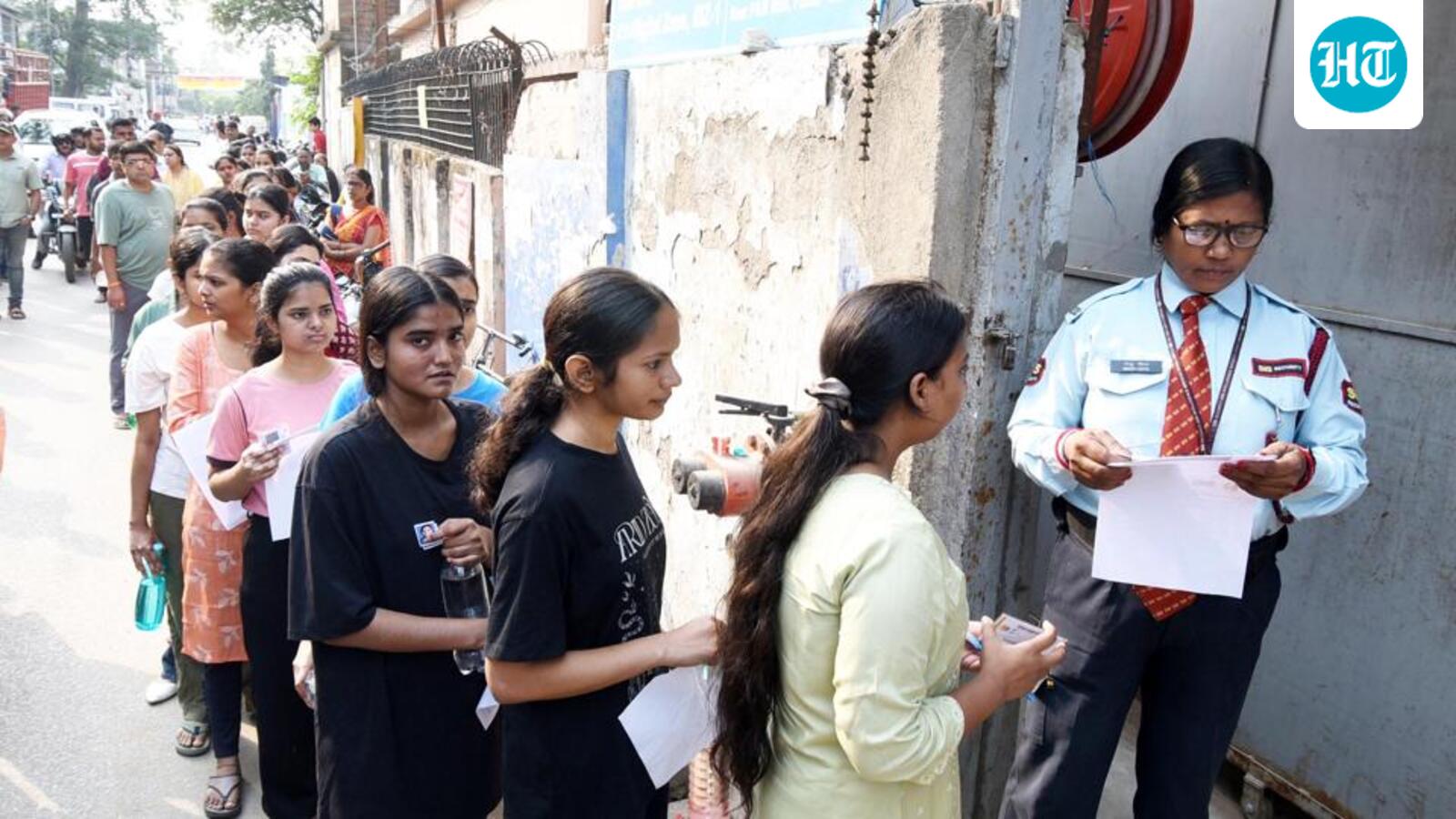
There was also the highest-ever female qualification rate in the recent six-year period. Of the 43,112 women registered (down marginally from 43,413 last year), 40,562 appeared in both papers and 10,107 qualified, taking the rate to 23.4%, up from 21.7% in 2025. Women accounted for 3,814 of the 18,861 IIT seats allotted, or about 20.2%, broadly in line with the 20% supernumerary-seat mechanism. A total of 37 women secured seats through the gender-neutral pool, with the remainder admitted through female supernumerary seats.
The hierarchy among IITs remains largely unchanged. Of the top 5,000 JEE-Advanced rankers, 4,632 were allotted seats in the 23 IITs. IIT Bombay accounted for the largest share, 764, followed by IIT Delhi (587), IIT Kharagpur (482), IIT Madras (477) and IIT Kanpur (454).
Together, the five institutes accounted for nearly 60% of the top-5,000 rankers who were allotted IIT seats. The pattern is similar to 2025, when the corresponding figure was about 59.5%. IIT Hyderabad’s share rose from 222 to 257, while IIT Kharagpur saw a sharper decline from 517 to 482 among top-5,000 allotments.
Concentration is even stronger at higher ranks. Among the top 500 rankers, IIT Bombay received 183, IIT Delhi 115, IIT Madras 78, IIT Kanpur 49 and IIT Kharagpur 40 — together 465, or 93%. Several newer IITs had none from the top 500. Year-on-year, IIT Bombay stayed at 183, Delhi edged up from 114, Madras from 77, Kanpur from 40, while Kharagpur fell from 47; the five leading IITs’ share strengthened slightly from 461 last year. Among the top 100 who secured IIT seats, 68 went to IIT Bombay, 18 to IIT Delhi, 11 to IIT Madras and one to IIT Kanpur.
Branch preferences show striking concentration in Computer Science and Engineering (CSE): 365 of the top 500 rankers — 73% — were allotted CSE programmes. IIT Bombay alone accounted for 142 of these. Only two of the top 500 chose Civil Engineering, while none opted for Aerospace Engineering.
Seventeen candidates chose AI and Data Analytics programmes, indicating newer technology-oriented options are attracting some top rankers but have not displaced CSE dominance.
Experts cautioned against reading the qualifier-seat gap or concentration of top ranks as simple calls for faster physical expansion or signs of failure by newer campuses.