'Not happy with the performance' - so why do England keep winning?
Football tactics correspondent Umir Irfan examines why England are still winning games despite Thomas Tuchel insisting performances are not good.
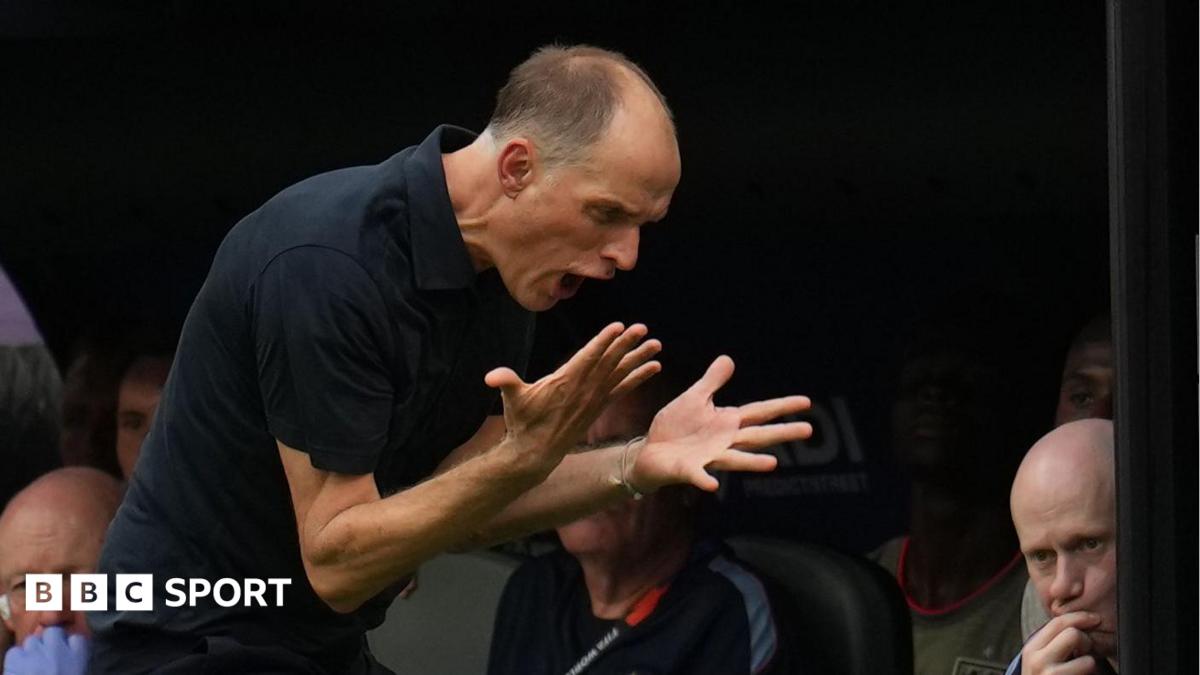
England fought hard to beat Norway in the World Cup quarter-final on Saturday, but manager Thomas Tuchel is clearly concerned.
"We made life very difficult for ourselves," Tuchel said. "The result is fantastic but I'm not happy with the performance."
He did follow these quotes up by commending the players for their heart: "I'm impressed with the effort, team spirit and belief to overcome adversity.
"But I am also a football coach and I think we can play better. We had a lot of momentum swings for both teams. We made life difficult in the way we played, sloppy, a lot of technical mistakes, not fast enough, not repetitive enough."
So, what did he want to see? And more importantly, if the side are not playing as they should be, why do they keep on winning?
Tuchel angry at 'lucky' England - but Bellingham defends players
Bellingham inspires England to beat Norway and reach World Cup semi-finals
How does Tuchel want England to play?
When Tuchel selected his World Cup squad, it was clear that he had a specific style of play in mind.
Players were selected based on how well they could perform in predefined roles – think Jude Bellingham and Morgan Rogers competing for the number 10 shirt pre-tournament.
These fixed roles are underpinned by a number of key principles, some of which are:
Play deliberate passes to entice opposition pressure
After enticing pressure, accelerate play, looking to find forwards in space
Against defensive blocks, attack down the flanks, using wide triangles and rotations to create chances
Throughout the World Cup we have seen these in glimpses, but Tuchel is unsatisfied.
What did Tuchel want to see against Norway?
Almost all of the issues Tuchel mentioned after the game were about how his side played on the ball, so for context, we need to look at England's attacking and Norway's defensive set-up.
Stale Solbakken's men defended in a 4-5-1 shape, blocking space, with England attacking in a 3-2-5 shape on the ball.
Marc Guehi, John Stones and Ezri Konsa made up the first line. Declan Rice and Elliot Anderson formed the two in midfield. Left-back Nico O'Reilly joined the front four, giving them an extra player against Norway's back line.
In his post-match critique Tuchel said England were "not repetitive enough", an uncommon phrase.
What he was most likely referring to was that he did not see his side have longer spells of possession consisting of lots of short passing, aimed at drawing Norway out.
This is something the German manager wants because it opens up space to find attackers in, either out wide or with long balls over the top.
In the group stage against Ghana, who also defended in a 4-5-1 block, Tuchel was heard telling his players to play "short, short, short" before looking for a "long switch", something we actually saw from England in the first quarter against Norway.
By playing numerous short passes on one flank, England drew the Norwegians towards the ball before quickly playing to the far-side winger in space, often Anderson playing long to Noni Madueke.
The wingers didn't capitalise on these moments but England showed glimpses of Tuchel's ideal attacking principles.
As the game went on, this repetitive baiting of pressure was seen less.
England struggled to hold the ball, with their first-half possession of 68% dropping to 44% in the second half.
The untapped potential of England's wide triangles
Positional rotations in the wide triangles for Tuchel were supposed to be the key attacking tactic England were to lean on throughout the tournament.
Much of Tuchel's post-match frustrations likely will have come from the fact that Norway's 4-5-1 gave the Three Lions the perfect conditions to use them, but England were "not fast enough".
The wide midfielders of Norway did not drop into the defensive line, instead holding their position in line with the central midfielders. Behind them, Norway kept a narrow back four.
This gave England multiple possible solutions through their wide triangles.
Using Anthony Gordon, Anderson and O'Reilly as an example below, we see the England winger move from a left-wing position into a more narrow position inside the Norweigan right-back, Julian Ryerson.
Norway's right midfielder, Alexander Sorloth, holds his zone, which means O'Reilly or Anderson could move into the space out wide behind him.
The zonal defending of Norway meant they were not tracking the movement of the England players, but instead looking to defend whoever arrived in their zone.