Risk of thunderstorms before England face Norway in Miami heat
Alongside high temperatures as England face Norway in Miami, there is a risk of thunderstorms, especially near the start of their World Cup quarter-final.
England will face Norway in Miami amid high temperatures and a risk of thunderstorms, especially near the start of Saturday's World Cup quarter-final (kick-off 22:00 BST).
Air temperatures are likely to sit about 33C (91F), but once you add in the humidity, it will feel like about 41C (106F).
The US National Weather Service (NWS) issued a heat advisory for the area on Saturday which warns that high temperatures and humidity may cause heat-related illnesses.
It is advising people to drink plenty of fluids, stay in an air-conditioned room and stay out of the sun.
In addition to how hot it will feel during the game, the Wet Bulb Globe Temperature (WGBT) will also sit around 29C to 32C.
The WGBT is an index which combines air temperature, humidity and surface temperature readings and is used by global sporting bodies such as Fifa to help keep players safe.
In its guidelines for playing in heat,, external players' union Fifpro says a WBGT above 28C should lead to the "delay or postponement of matches" until conditions are safer.
Fifa's emergency care manual states a higher reading of 32C is the point at which "cooling breaks must be used or the match may be either postponed or cancelled".
Hydration breaks have been a standard component of every game in this World Cup, taking place midway through each half.
There is no suggestion that the game will not take place.
However, if there is lightning within eight miles of the stadium then kick-off could be delayed.
England's last-16 win over Mexico started an hour later than scheduled because of thunderstorms around the Azteca.
England in unknown territory
England head into unknown territory against Norway - playing in searing temperatures.
The Three Lions have been largely shielded from excess heat in North America.
Their schedule has included indoor matches in Dallas and Atlanta, and the three they have played outdoors - in Boston, New Jersey and Mexico City - have been in cooler, damper conditions.
That changes for their quarter-final, which could be played in conditions Fifpro considers too dangerous for the game to go ahead.
Norway have played all but one of their matches outdoors - the exception being their last-32 victory over Ivory Coast in the air-conditioned Dallas Stadium.
Their 2-1 victory over Brazil on Sunday was played outside while New Jersey was under an NWS extreme heat warning.
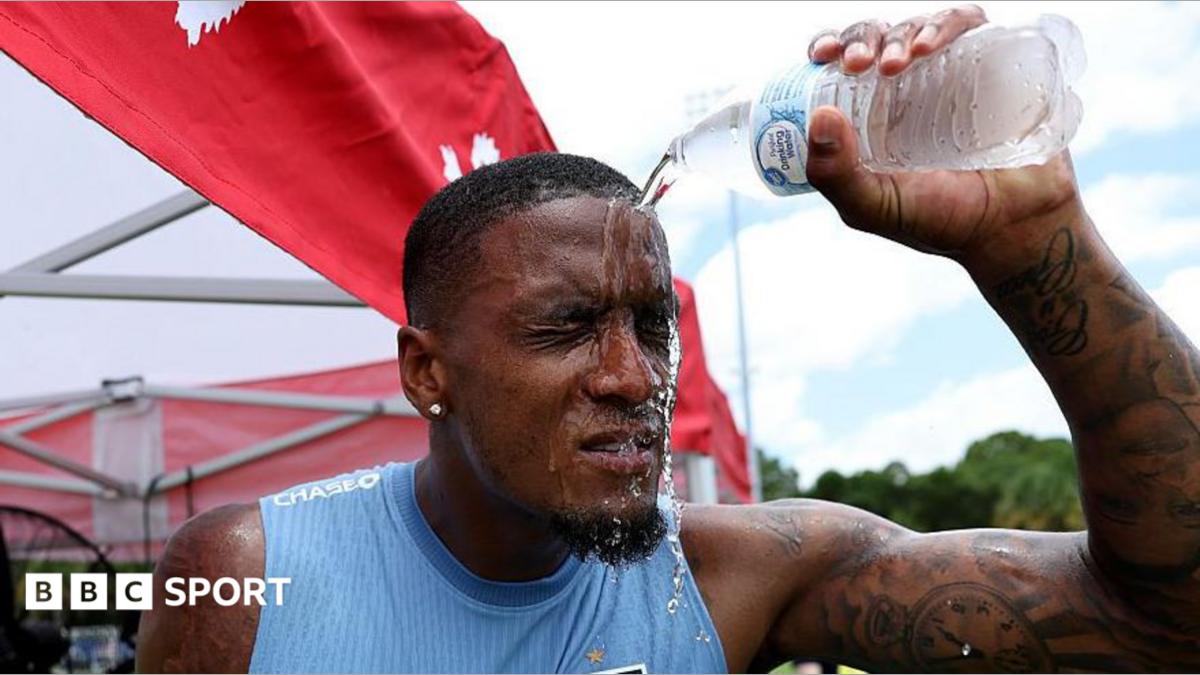
So who might be better prepared for the heat of Miami?
Check the forecast for Miami
What temperatures have Norway and England faced?
While two of England's group-stage matches were played in the hotter Texas and Georgia climates, they felt the benefit of air-conditioned stadiums, where the temperature is set to a comfortable 21C.
The warmest the Three Lions have played in was 25C for the final group game against Panama, but that featured overcast skies.
July is Mexico City's wettest month of the year, so when England headed to altitude last Sunday they would have felt at home - 18C and rain.
The hot and humid weather in Miami will be a very different challenge.
Norway's tournament opener against Iraq, meanwhile, was played under clear skies and in a temperature of 25C.
There was rain and cloud during their games against Senegal and France, though they rested most of their first-choice players against Les Bleus.
After being indoors against Ivory Coast, Norway experienced oppressive conditions in the victory over Brazil. The temperature in New Jersey hit 31C in the shade, but on the pitch the heat and humidity would have made it feel far hotter.
Are England going to be ready for the heat?
England's initial base when arriving in the United States was, coincidentally, Florida.
Thomas Tuchel and his team spent 10 days in the area, playing warm-up games against New Zealand in Tampa and Costa Rica in Orlando.
The Three Lions then moved to their tournament facility in Kansas, where daily air temperatures are about 32-34C (90-93F).
That should help England cope with the heat.
Dr Lee Taylor from Loughborough University - a leading expert in elite athlete performance and the challenges of heat and altitude - told BBC Sport acclimatisation was crucial.
"That is the gold-standard method to protect players' health and performance," said Taylor.
"They've been getting those exposures into the players pretty consistently as they had two hot bases.
"So we're fairly certain those players are acclimated. They haven't been able to really test that in a game environment, but we're not too concerned because we know they've acquired those physiological adaptations."