Section 163 imposed in parts of New Delhi ahead of CJP's Parliament march: What it means and what's prohibited?
Police are maintaining constant surveillance in and around the protest site, while additional personnel have been stationed at strategic locations. | India News
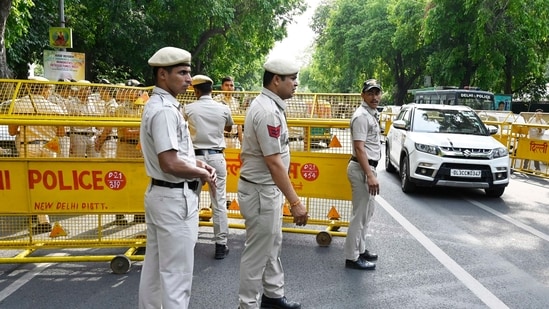
Police are maintaining constant surveillance in and around the protest site, while additional personnel have been stationed at strategic locations.
Security has been tightened across the New Delhi district ahead of the Monsoon session of Parliament and the Cockroach Janta Party's (CJP) proposed ‘Chalo Sansad’ march on Monday, July 20, with the Delhi Police imposing prohibitory orders under Section 163 of the BNSS.
The heightened security comes after the CJP announced the march to protest alleged irregularities in the NEET examination and demand the resignation of Union education minister Dharmendra Pradhan.
Also read | Delhi Police ‘won’t allow' CJP's Parliament march on July 20, calls it ‘illegal’
Why were the restrictions imposed?
Deputy Commissioner of Police (DCP) Sachin Sharma issued a public advisory on X on Sunday, stating that the "Delhi Police categorically clarifies that no permission has been sought or granted for any such protest march/procession."
"Accordingly, protest marches, processions, demonstrations and assemblies of five or more persons are strictly prohibited, except at the designated protest site at Jantar Mantar, with prior permission," the Delhi Police said in its post on X.
Preventive deployment will remain in place throughout the Parliament session, police added.
Also read | White sheets, plainclothes cops: How Delhi Police ‘removed’ Sonam Wangchuk amid sea of protesters
Under the order, the following activities are prohibited in the New Delhi district:
* Holding of any public meeting
* Assembly of five or more persons
* Carrying fire-arms, banners, placards, lathis, spears, swords, sticks and brickbats
* Processions and demonstrations
* Picketing or dharnas at any public place within the specified area without written permission
Area covered and legal provisions
The restrictions apply to the entire area of the Sub-Division Parliament Street, excluding the exempted area of Jantar Mantar Road shown in the map annexed with the order. The order states that activities in the exempted area may be allowed beyond 5:00 pm if prior written permission is obtained.
Also read | 'No hospital can force its treatment on patient': Sonam Wangchuk's wife after HC denies request to shift activist
The order has been issued by Ajay Sharma, Assistant Commissioner of Police, Sub-Division Parliament Street, New Delhi District, under powers exercised under the Delhi Police Act, 1978, read with Section 163 of the Bharatiya Nagarik Suraksha Sanhita (BNSS), 2023.
It also states that anyone violating the order will be punishable under Section 223 of the Bharatiya Nyaya Sanhita (BNS), 2023.
Follow the latest breaking news, major developments and agenda-setting stories from India and around the world with the newsdesk at Hindustan Times. Operating round the clock, the desk brings together experienced editors, reporters and correspondents to deliver fast, accurate and contextual reporting across subjects that influence public policy, governance, business, society and international affairs. The HT News Desk covers politics, elections, government policies, the economy, business and markets, science and technology, the environment, law and order, infrastructure, education, climate issues and geopolitics, while closely tracking developments across states, institutions and global capitals. The team also leads coverage of major breaking news events, policy announcements, court proceedings, natural disasters, public emergencies and significant international developments. Reports published by the newsdesk are based on information gathered from reporters on the ground, official statements, government agencies, court records, regulatory filings, recognised institutions and other authoritative sources. Stories undergo editorial scrutiny and verification processes to ensure accuracy, fairness and relevance, and are updated as events evolve and additional information becomes available. Whether covering a key political decision in New Delhi, an economic policy shift affecting millions, a landmark court ruling or a major global event, the HT News Desk aims to provide readers with reliable, fact-based journalism that delivers not only the latest developments but also the context and analysis needed to understand their wider implications.Read More