The phone book that led us to Assad's spy chief in hiding
How we tracked down "The Spider" who was once one of the most-feared men in Syria.
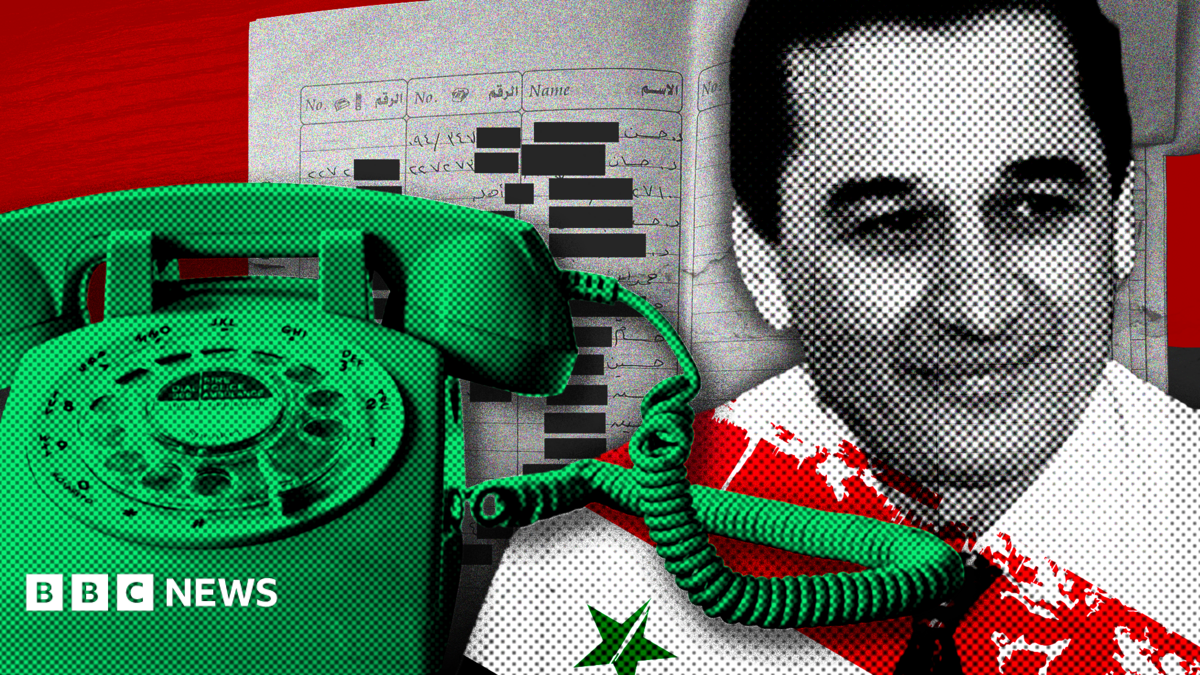
In an abandoned luxury apartment in the Syrian capital Damascus, armed men dressed in military fatigues sifted through designer clothes and documents.
Scattered across the living room floor, under a sparkling crystal chandelier, were dozens of photos of the same slender man in different settings - sitting at his desk, even playing in the snow. And multiple prints of the same image, showing him smiling warmly as he shook the hand of ousted dictator Bashar al-Assad.
The man was not instantly recognisable, but gold medals and gilded certificates piled nearby were inscribed with the name Hussam Luka.
Known as "The Spider", Luka was one of Assad's top henchmen, accused of orchestrating atrocities and systematic torture, and sanctioned by the UK, US and European Union.
As head of Syria's most powerful civilian intelligence agency, Luka was among the most feared men in the country. But much of his work was conducted from the shadows.
Like others in the regime, Luka seemingly vanished overnight in December 2024 when Assad was toppled, leaving a trail of unanswered questions and demands for justice that many fear will never be realised.
In his apartment, days after Assad's fall, we watched the rebels looking for clues as to where he might have gone.
In the corner of the living room, on a console table, was an unremarkable-looking notebook.
Inside, in scribbled blue handwriting, we found dozens of names - from shopkeepers and doctors, to military officials and people with the Luka family name.
Could these contacts help us learn more about The Spider and his crimes, or even help us to track him down?
At one time, Luka's own phone number was hard to avoid - in the early days of the Syrian civil war, it had been spray-painted on walls around the central city of Homs.
The conflict was sparked by Assad's brutal crushing of a pro-democracy uprising in 2011 - a war in which hundreds of thousands of people would go on to be killed.
Luka was a local head of the Political Security Directorate, one of Assad's main intelligence agencies, and had been given the task of wresting the city from the rebels.
At the time, rebel-held areas in Homs were under siege by the government, and residents were struggling to access food and medicine. Several people, including former rebel fighter Motaz al-Zaydi, told us they had resorted to eating rats.
Al-Zaydi remembers Luka's name and phone number appearing on a wall in his neighbourhood, and said the message began to spread that those wanting to flee the fighting could phone the number for safe passage.
Some are believed to have been granted safe transit out of the city by Luka, but others who called the number were never seen or heard from again, according to several people we spoke to, including al-Zaydi.
Many told us they referred to Luka as "The Spider" because of his vast web of allies and informants, including some embedded in rebel groups. "He was everywhere," Homs residents told us. Al-Zaydi described Luka as an "evil genius" and "a fox of a man".
But his most egregious action in the city, many argue, was his alleged involvement in the so-called Eid Massacre, known by some as the Children's Massacre, which the US noted when sanctioning him.
It was the Muslim holiday of Eid al-Adha in September 2015, and Mohammed Towakatli's seven-year-old, Wael, was gardening in the playground he had set up in the al-Waer neighbourhood.
At 17:10, just after the power ration had kicked in, Mohammed remembers the strike hitting.
As Mohammed walked around the park earlier this year, now planted with rows of saplings, he recalled the names of the children killed and the games they had been playing at the time, gesturing to the places where he had found their bodies, including that of Wael.
"They were tiny children," he said with tears in his eyes. "The ground here was painted red with blood."
Twenty-eight people were killed, including 17 children and four women, according to the Syrian Network for Human Rights.
Luka, according to a Syrian activist group, and a pro-opposition newspaper at the time, was responsible for the regime's selection of targets in the area that day.
His actions in Homs earned him a promotion, and by the time of the regime's collapse he ran the General Security Directorate (GSD) intelligence agency, making him one of the most powerful people in the country.
The government security services could target anyone - from opposition fighters, journalists, doctors, or rights activists, to people believed to be opposed in any form to the Assad government.


