The 'ultimate all-round sportsman' - Sobers could do it all
Sir Garfield Sobers, who has died aged 89, was rightly chosen as one of the leading five cricketers of the 20th century - and will be remembered as arguably the best all-rounder in the history of the game.
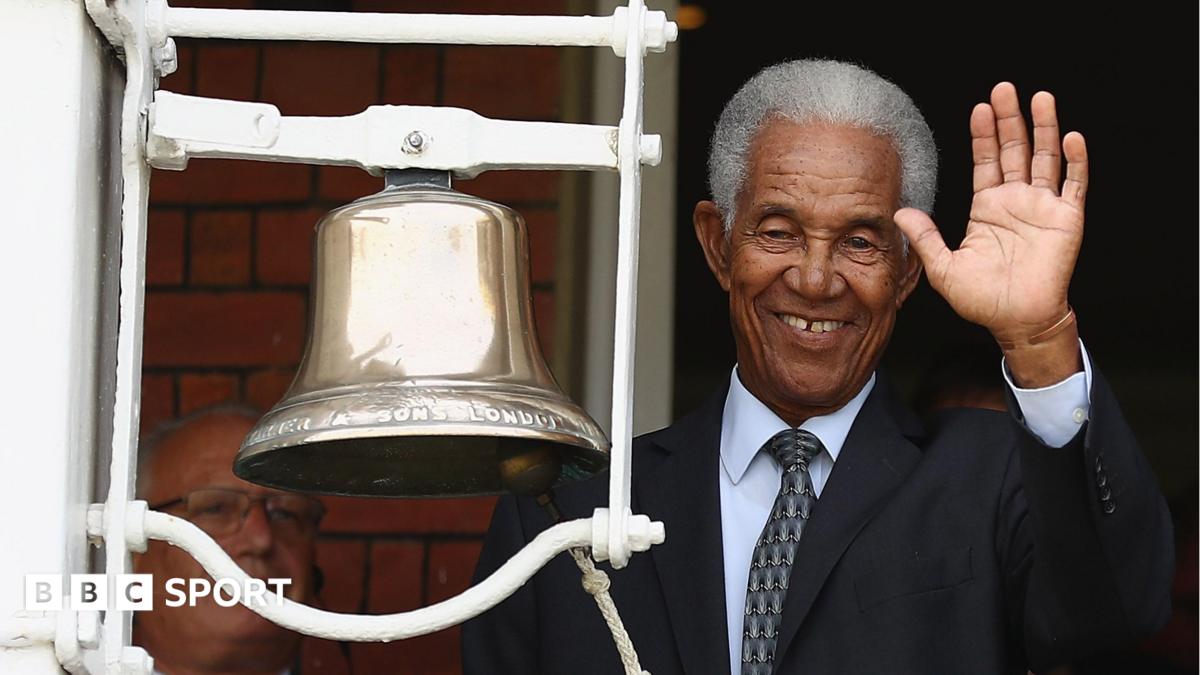
Sir Garfield Sobers, who has died aged 89, was rightly chosen as one of the leading five cricketers of the 20th century - and will be remembered as arguably the best all-rounder in the history of the game.
A national hero of Barbados, he was a legend in the West Indies on the back of a Test career that spanned 20 years, and was knighted soon after his retirement.
But he will also be fondly remembered in England after playing for county side Nottinghamshire - for whom he wrote his name into the record books when he became the first man to hit six sixes in an over in a professional game.
Decades before coaches began to insist their players be 'multi-dimensional' cricketers rather than only contributing in one facet of the game, Sobers was the ultimate all-round sportsman.
A hard-hitting left-handed middle-order batter, he was capable of bowling in three distinct styles, as well as being an athletic fielder and a fine close catcher.
Indeed, he would often take the new ball, bowling left-arm fast-medium - and then return later in the innings having switched to orthodox left-arm spin, or even left-arm wrist-spin. When added to his batting and fielding, he was a captain's dream - effectively five cricketers in one.
West Indies legend Sobers dies aged 89
From Barbados to the world stage
Garfield St Aubrun Sobers was born in Bridgetown on 28 July 1936, but was only five when his merchant seaman father was killed in World War Two, leaving his mother Thelma to raise half-a-dozen children. Young Garry was born with an extra finger on each hand, which were removed during childhood.
Having excelled at several sports as a schoolboy, he was recruited to local club cricket in his early teens and made his first-class debut at the age of 16 against the Indian tourists at his home town's Kensington Oval - the ground whose pavilion would one day bear his name.
Sobers was selected to bat at number nine and bowl spin for a star-studded Barbados line-up - he was one of eight current or future Test players, of which no fewer than four would be knighted. He took four wickets in the first innings and three in the second.
And with only one other first-class appearance under his belt, his Test debut came 14 months later as a 17-year-old chosen to take on England in the final Test in Jamaica in early 1954 after the Windies' regular left-arm spinner Alf Valentine fell ill. Again, he captured four wickets on debut.
Although the famous 'Three W's' - Clyde Walcott, Everton Weekes and Frank Worrell - were the established middle order, Sobers was elevated to number six on his next Test appearance when Australia toured in 1955, and soon showed signs of his all-round quality.
Having made 47 in the second Test, he found himself as an emergency opener in the fourth, where he hit the first three balls he received - from legendary Aussie all-rounder Keith Miller - for four.
Sobers toured England for the first time in 1957, and despite only recording one half-century in five Tests, he lit up Trent Bridge - a ground where he would later shine - with an unbeaten 219 against his future county side Nottinghamshire.
Record breaker in Jamaica
Though a player of undeniable potential, it was four years into Sobers' Test career before he broke three figures for the first time, in his 17th Test - but spectacularly rewrote the record books in doing so.
Coming in at number three against Pakistan at Jamaica's Sabina Park, Sobers shared a mammoth second-wicket stand of 446 with Conrad Hunte, who was run out for 260 - but by the time West Indies declared on 1 March 1958, Sobers - still only 21 years old - was 365 not out.
It broke the previous record Test score of 364 set by England's Len Hutton in 1938, and would remain a record until 1994. But it was also the harbinger of a purple patch of batting form for Sobers, who hit five further centuries in his next five Tests, and as his seam bowling improved, he became the world's leading all-rounder of the 1960s.
Sobers was a man in demand - playing in England for Radcliffe in the Central Lancashire League between 1958 and 1962, and Norton in the North Staffordshire and South Cheshire League from 1964-1967. Meanwhile, his success in Australia in 1960-61 earned him an invitation to play for South Australia in the Sheffield Shield for three subsequent seasons.
However, his time at Radcliffe included a tragic incident when a car he was driving collided with an oncoming cattle truck in Staffordshire. His Windies team-mate Collie Smith, who was sleeping in the back seat, suffered spinal injuries and died three days later. Sobers was found guilty of careless driving and fined.