These seaside apartments were a ghost city - then police say scammers moved in
Malaysia's Forest City was pitched as "paradise" but last month police raided it over alleged scam operations.
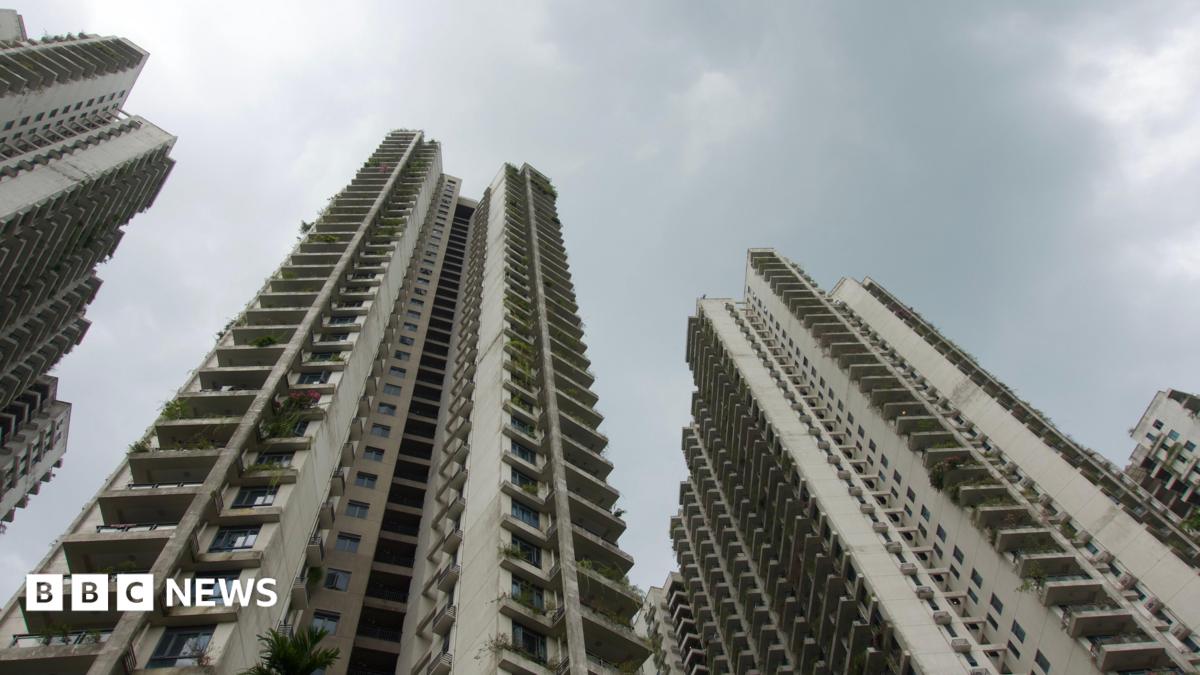
From a distance, Malaysia's Forest City looks 3D-printed: a bristle of identical white blocks clustered on an otherwise unremarkable coastline.
When it was unveiled by Chinese developers in 2016, the $100bn mega-project was pitched as "a dream paradise for all mankind": a special financial zone that could house some 700,000 residents. But a decade later, this 14-sq-km (3,400-acre) artificial island on Singapore's doorstep is thought to be inhabited by less than 1% of that.
Rows of eerily vacant skyscrapers loom over quiet streets. Inside empty apartments, benchtops and windows are filmed with dust.
"In 2016 they described it here like the golden city; very, very beautiful," says Jason Deng, a 56-year-old investor who was among the first to buy in Forest City, paying "a lot of money" for five properties.
"If I had known it was not so good I would not have bought so many apartments," he says now. "I thought it would be much, much better."
As it turns out, this is only a golden city for some people – and they're not the ones developers had hoped to attract.
In mid-July, Malaysian police raided two alleged scam operations spread across 32 premises in Forest City, arresting 335 people and seizing assets worth about one million ringgit (£181,810; $245,000), including 313 computers, 1,557 mobile phones, 17 laptops and 10 modems.
From these two call centre hubs – one occupying 27 apartments across five storeys of a residential tower, the other spread between five bungalows – cryptocurrency syndicates ran investment and love scams targeting victims abroad, according to police.
Those arrested include 309 Chinese nationals, 19 Indonesians, three Malaysians and four Myanmar nationals. Johor police chief Ab Rahaman Arsad said authorities were working with Interpol to track down the mastermind behind the operations.
The BBC reached out to Forest City and Johor police for comment, but did not receive a response.
Experts and locals tell the BBC this is likely to be the tip of the iceberg – and a symptom of a global scam industry that is spreading, evolving, and professionalising.
"The reality is that many of these organisations now resemble multinational corporations more than a traditional organised crime network or gang," says John Wojcik, an analyst at TRM Labs, which investigates crypto-facilitated crime. "They have dedicated recruitment teams, IT departments, money-laundering specialists and infrastructure."
Authorities and experts agree that the Forest City operations were probably staffed by criminals who had been driven out of Cambodia, a global nerve centre for transnational scams.
Over the past five years, this criminal sector has ballooned into a multi-billion-dollar industry, built on the forced labour of brutalised trafficking victims who work under threat of torture and abuse.
Since late last year, the Cambodian government has stepped up efforts to stamp out these operations. Authorities recently estimated that 300,000 people had left the country within a few months as raids on industrial-scale compounds intensified.
But these Malaysian offshoots do not appear to have been scam "compounds" in the traditional sense.
Compared to more infamous walled complexes in places like Sihanoukville or the Myanmar borderlands, the alleged scam hubs in Forest City appear almost white collar, reportedly staffed by local residents and sitting wall-to-wall with the homes of unsuspecting neighbours.
Kevin, a tenant who also works in property sales for Forest City, believes scammers are still operating in "condominiums or serviced apartments" in the complex. He asked for his name to be changed for fear of repercussions.
"We know what they're doing," he says. "This is actually a very common issue in Johor city and Kuala Lumpur, but especially in Forest City. Forest City is very special."
Part of what makes Forest City "special", according to Kevin, Wojcik and others, is the very thing that has gained it so much notoriety: its reputation as a semi-abandoned "ghost city".
"When we speak to clients or customers, the company teaches us to say 'we already have 23,000 residents living in this area'," says Kevin – but the reality, he quietly adds, is there are "less than 5,000".
"That's the reason" scammers have chosen Forest City to set up shop, he suggests.
"They have their own privacy... Nobody comes here."
There are several factors which precipitated what many see as the downfall of Forest City.
Spearheaded by Country Garden, one of China's largest property developers, and Danga 88, a private company controlled by Malaysian Sultan Ibrahim Iskandar, the project was initially dreamed up as an eco-friendly metropolis for well-heeled Chinese clients. Featuring a high-end hotel, golf course and water park, the resort-style city's seafront offices and apartments were expected to be in high demand.


