Ajit Doval hosts 5th BIMSTEC National Security Chiefs' meeting in Delhi; members adopt key maritime security guidelines
The NSAs and Heads of Delegations held extensive discussions on practical and result-oriented measures to strengthen regional security. | India News
The NSAs and Heads of Delegations held extensive discussions on practical and result-oriented measures to strengthen regional security.
National Security Adviser (NSA) Ajit Doval on Thursday hosted the 5th Meeting of the BIMSTEC National Security Chiefs in New Delhi, bringing together delegations from Bangladesh, Bhutan, Myanmar, Nepal, Sri Lanka and Thailand to discuss regional security cooperation and emerging strategic challenges.
The meeting underscored the growing importance of the Bay of Bengal Initiative for Multi-Sectoral Technical and Economic Cooperation (BIMSTEC) as a bridge between South Asia and Southeast Asia, two of the world's most dynamic regions connected through the Indian Ocean. Over the years, BIMSTEC has expanded cooperation across key sectors, including regional security, disaster management, transport and trade connectivity, technology and people-to-people exchanges.
Also Read | Why Punjab could define India’s new national security leadership
During the meeting, the BIMSTEC Secretary General presented a comprehensive overview of the progress made in the security sector and briefed member states on developments across multiple areas of cooperation under the regional grouping.
The NSAs and head of delegations held extensive discussions on practical and result-oriented measures to strengthen regional security. Deliberations focused on enhancing cooperation to combat terrorism and organised crime, improving cybersecurity, ensuring maritime and energy security, boosting regional connectivity and strengthening disaster management mechanisms. The participants also exchanged views on addressing new and emerging security threats confronting the region.
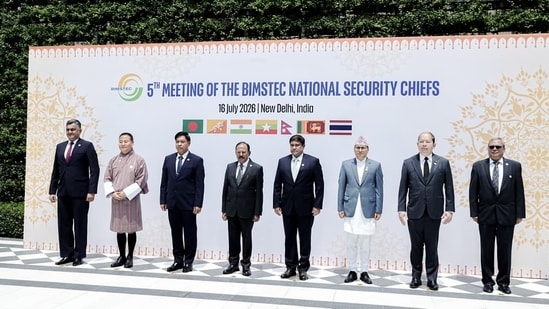
A key outcome of the meeting was the adoption of guidelines for the maritime component of humanitarian assistance and disaster relief (HADR). The guidelines are expected to enable BIMSTEC member states to coordinate and undertake relief operations across the region more effectively and in a time-bound manner during natural disasters and humanitarian emergencies.
The member states also endorsed a set of guiding principles for maritime law enforcement agencies during interactions at sea. These principles are aimed at improving predictability, promoting safety and enhancing coordination among maritime agencies of BIMSTEC countries during operational engagements.
As BIMSTEC prepares to mark its 30th anniversary next year, the participating NSAs reaffirmed their commitment to strengthening regional collaboration and institutional capacity.
They reiterated the need for greater knowledge-sharing and closer cooperation to build resilience against traditional and non-traditional security challenges while reinforcing the region's collective ability to respond to evolving threats.
Author of Indian Mujahideen: The Enemy Within (2011, Hachette) and Himalayan Face-off: Chinese Assertion and Indian Riposte (2014, Hachette). Awarded K Subrahmanyam Prize for Strategic Studies in 2015 by Manohar Parrikar Institute for Defence Studies and Analyses (MP-IDSA) and the 2011 Ben Gurion Prize by Israel.Read More