How Rang De Basanti created a challenging storyboard for future filmmakers
Discover how "Rang De Basanti" revolutionized filmmaking with its innovative narrative and impactful social commentary for future creators.
You don’t have any Active Subscription.
Your active subscription(s)
Account subscription benefits alongside Premium Stories, Editorials, Opinions and more. Unlock these with Subscription
Products you've access to
Additional Subscription Benefits
Need help with your subscription?
Rang De Basanti set a trend in filmmaking with its unconventional narrative style
Updated - August 03, 2026 06:28 pm IST
In one of Rang De Basanti’s (RDB) many moments of frank criticisms, Aamir Khan’s character, Daljeet, comes up with a dehati (rustic) logic to sum up the complexities of today’s India. He says: “With one leg in the past and one in the future... it’s no wonder we’re peeing on the present.” Incidentally, the film’s narrative style, with the past and the present running parallelly, did create a convincing and challenging storyboard for future filmmakers.
Siddharth on ‘Rang De Basanti’ connect in ‘Operation Safed Sagar’: The coincidences are ridiculous
Rang De Basanti was a truly daring film — its success, connect, influence and referencing (cinematic and academic) is a testament to that fact. For those interested in studying people’s movements of the early 21st century India, like Anna Hazare’s ‘andolan against corruption’ (2011) , it would be worth researching the role of new millennium celluloid social critiques like Rang De Basanti and Lage Raho Munna Bhai (2006).
The film’s idea of peaceful candle light protests to voice the common man’s angst against a corrupt system, found itself replicated by those campaigning for justice in the Jessica Lal murder case, a fact acknowledged by the makers of No One Killed Jessica (2011), a film based on the trial.
Rang De Basanti begins with British filmmaker Sue McKinley’s (Alice Patten) desire to make a documentary film on the five young freedom fighters — Bhagat Singh, Chandrasekhar Azad, Rajguru, Ramprasad Bismil and Ashfaqullah Khan — who never lived to see an independent India.
The trigger happens to be her grandfather James McKinley’s accounts in his personal diary as a jailer in pre-independent India. Sue’s decoding of her grandfather’s ‘silent’ interactions with those revolutionaries on death row, inspire and urge her to a point of creative obsession to voice those silences through a popular, visual medium like cinema.
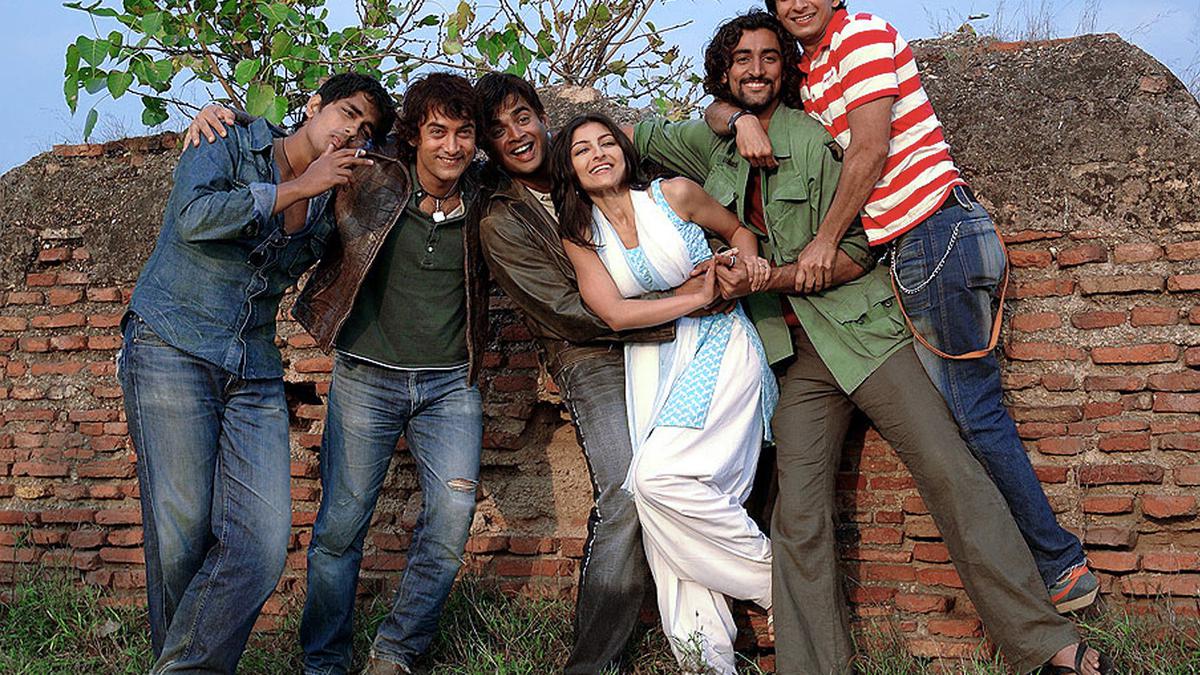
On reaching India, Sue however, has to first contend with the frustration of not finding good actors, who can understand and emote the essence of those young revolutionary heroes, until her host, friend and a Delhi University student, Sonia (Soha Ali Khan) introduces her to an eclectic and talented, yet seemingly aimless college gang of DJ (Aamir Khan), Sukhi (Sharman Joshi), Aslam (Kunal Kapoor) and Karan Singhania (Siddharth) apart from Sonia’s fiancé Ajay Rathod (Madhavan), and a Hindutva foot soldier Laxman Pandey (Atul Kulkarni). They are not only representatives of the modern Indian youth in its varied aspirations, but also in a clever twist of social context setting, represent the religious, social and economic diversity of India. So, you have a rich boy, a working-class boy, a middle-class boy, and a man employed with the defence services — between them hailing from Hindu, Muslim and Sikh communities.
Interestingly, when Sue recruits DJ and his pals to play the roles of the young freedom fighters, she’s surprised by their lack of interest in these Indian heroes she’s been idolising all along. Their disregard for history and an attitude of uprootedness, is, however, abruptly transformed when Ajay dies in a plane crash because of the faulty parts in the old MIG fighter plane he was flying. To deflect the media’s probing questions on corruption in defence sector purchases, the defence minister defames Ajay’s sacrifice on TV. DJ and his gang, meanwhile, to honour Ajay’s memory and reputation, plan a peaceful candlelight vigil at India Gate. Police crackdown follows, in which Ajay’s mother is critically wounded and goes into a coma. That’s when DJ and his friends, inspired by their recent date with revolutionary history, feel impelled to kill the defence minister.
But when the dead minister is honoured as a martyr, DJ and his friends plan to hijack the All India Radio station to put forth their side of the story. Karan admits on radio that they killed the defence minister and argues how Ajay was a true hero. But their plan to surrender themselves backfires and they are all killed under orders that no one should survive to tell their story any further.
So, what is it about Rang De Basanti that makes it such a special film? Is it just the fact that it has contemporary youth characters and relatable images of male bonding not often seen in Hindi cinema (notable exceptions being Dil Chahta Hai, Rock On, 3 Idiots, Zindagi Na Milegi Dobara). Well, this is a truly global film coming out of Bollywood, where East meets West sharing unusual, common concerns. A British citizen comes to India to awaken in its youth respect for some of the nation’s real heroes but the educated Indian youth may see it cool to be disconnected with its history. But then history repeats itself and how.


