Why electric cars cost more to insure - and what's being done about it
The insurance cost of electric vehicles is still putting off many would-be buyers. So what can be done about it?
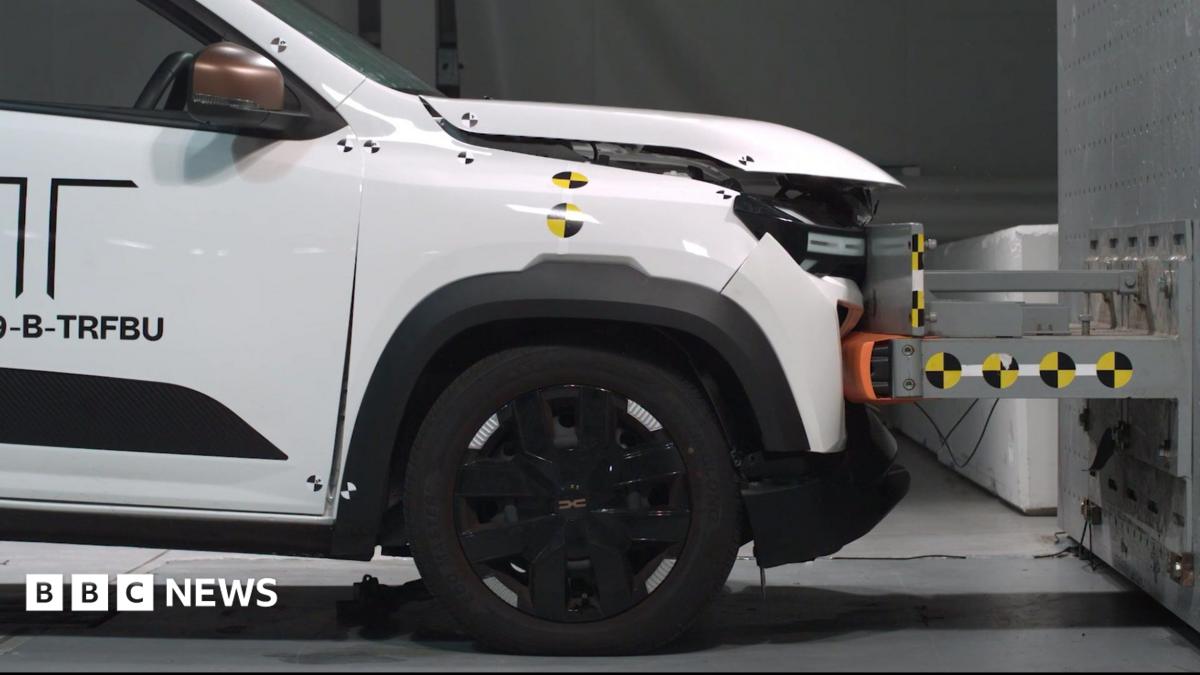
It's hot and bright beneath the high intensity lights in a cavernous crash and safety testing laboratory, hidden away in a business park outside Newbury.
A siren blares and a disembodied voice counts down: "Three, two, one." A small white car trundles into view, rolls across the floor, and bumps into a barrier set against the wall.
As crash tests go, this one is hardly spectacular. There is no torn metal or flying glass. At just 6mph, it replicates the kind of annoying prang you might well get in a car park or at a traffic light.
But raise the slightly bent bonnet to look underneath, and it's a different story. This is an electric vehicle (EV) – a Dacia Spring – and the hidden damage is significant.
As senior test engineer Sean Hoad points out, the high-voltage charging port, mounted at the front of the car is badly broken, as are components it's attached to.
"This is all one big unit, meaning we can't just replace the front charge port. We have to replace the charger itself, the inverter, and some of the cabling," he explains.
Repairing all of that, he says, would cost about £4,000, and there is other damage to consider as well, so the chances are an insurer would not bother getting it fixed.
"It's more than likely this car would be written off," he adds.
Thatcham Research, which works on behalf of the insurance industry, is carrying out tests like this to understand why EVs typically attract higher insurance premiums.
On average, it says, EVs cost 30% more to repair than petrol or diesel models, and it takes 14% longer to fix them.
This then feeds through to the insurance price. It can cost 10-25% more to insure an EV than a petrol or diesel car, depending on the make and model.
So, why is it so expensive? And what can be done about it?
According to the latest data from the Society of Motor Manufacturers and Traders (SMMT), EV sales have surged to the point that they made up almost one in every three new cars sold in the UK in June, external.
Ian Plummer, chief customer officer of car selling website Autotrader, says the rising EV demand is "driven by intensifying competition and rising consumer interest in plug-in cars".
However, he said "the wider context remains fragile, with ongoing uncertainty around policy, incentives, and wider external pressures".
The insurance cost is one of those niggling concerns that could put off would-be buyers.
"It's absolutely crucial electric vehicles become cheaper to insure," insists Steve Fowler, co-founder of the car review website Carblah.
"They are expensive – though not as expensive as some people might think – but by making them easier to repair and cheaper to insure, more people will buy them."
The issue, it seems, comes from the way many EVs are designed.
"There's a real focus on keeping weight down, because electric vehicles are heavy," says principal advanced technologies engineer Dan Harrowell.
"To save some weight, there's a lot of integration of components. They're glued together, rather than using fixings, which is great to reduce weight, but not great for repair, because you have to replace whole systems rather than individual components."
In a nearby workshop, a nearly-new model from a mainstream manufacturer is jacked up on a ramp.
This car was brought in following a relatively minor accident, and Harrowell points to a few scratches and scrapes on the protective casing of the battery underneath the car.
The core of the battery, containing the cells which provide power for the car, is unharmed. But because the whole assembly is supplied as a single unit, it would need to be replaced in its entirety for a full repair.
Given the battery makes up about 40% of the value of the whole car, replacing it would be too expensive.
"Damage to the battery is much less common, but the sheer value of it means any damage at all, if it involves a replacement, risks writing off the vehicle," he says.
Making batteries easier to repair might help solve this problem, although industry sources suggest insurers themselves have proved resistant to the idea.
The surge of Chinese EV makers coming into the UK market has also created a few headaches, Harrowell adds.
Labour rates in China are much lower, which means there is little incentive to minimise the amount of work needed to mend a car. In Europe, labour costs are much higher, so the process of repairing a car needs to be simpler.
"We've had to work with them to really help them to understand the difference in our market," he explains.