Burnham's 'Manchesterism' got him to No 10 - but will it work for the UK?
Economics editor Faisal Islam examines whether the north-west city can be a template for the entire country.
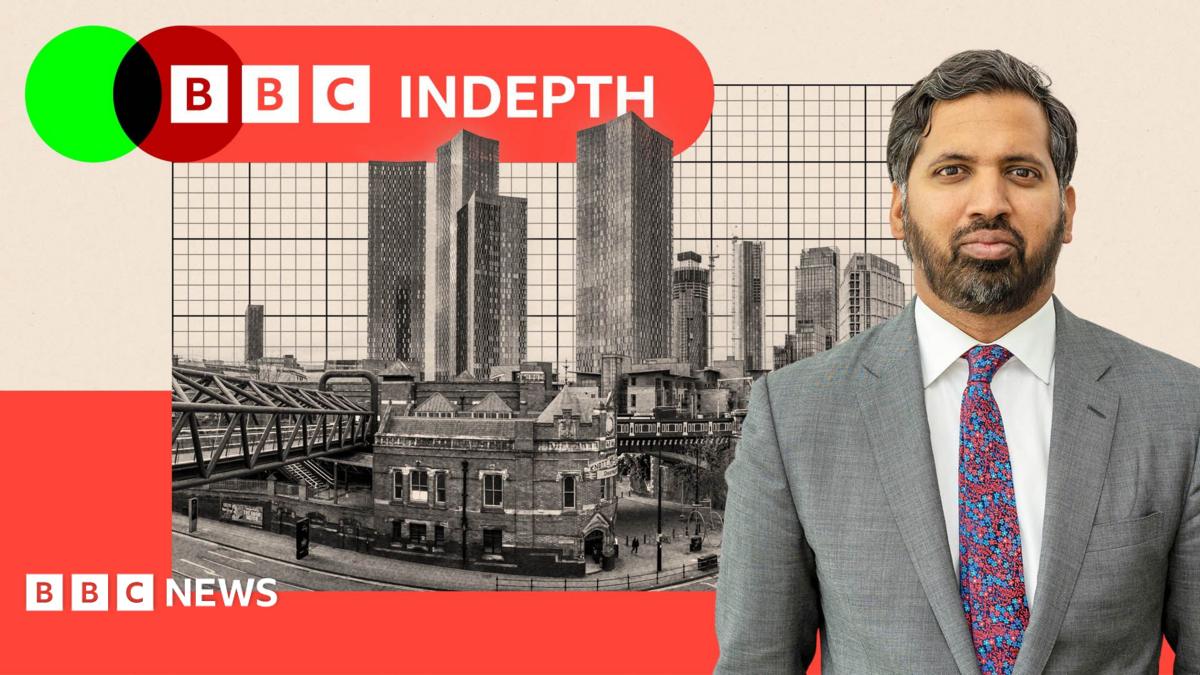
It was just five months ago when Andy Burnham retreated to his mayor's office in Manchester, having been blocked by Labour's ruling executive from standing for parliament.
When I met him there a few weeks later, he told me he planned to deal with his disappointment with some ambitious plans for his city region.
Burnham told me he wanted to appeal directly to Fifa to host the final of the women's football World Cup in 2035 Manchester instead of Wembley. "Imagine how electrifying that is for any girl growing up in the north of England," he said.
He said he was also joining forces with other mayors for a "Great Northern" Olympic bid across the north of England, and a plan was also afoot to host the Ryder Cup in Bolton. Sports bodies needed "re-educating" about the rest of the country, he said.
Manchester has already poached the Brit Awards from London after half a century in the capital.
Big, bold gestures like these tell part of the story of what has happened in the city. Burnham's civic ambition is a byproduct of Manchester's status as the fastest-growing city economy in the country. As Burnham prepares to become prime minister, will he be able to apply the same model to the whole of the nation?
Even before Burnham returned to parliament in June, there has been talk of Manchesterism as a political-economic philosophy that offers a programme for national transformation, rooted in a critique of a currently unresponsive, over-centralised British state.
The city has a long history of blending the freest of free markets with a strong social spirit. Manchester's cotton traders championed free trade and liberal economics, at the same time as the emergence of the co-operative movement, the trade unions and the Suffragettes. Even the Manchester Ship Canal, the emblem of monopoly-breaking free trade, required local government intervention backed by the workers.
But for an understanding of contemporary Manchester, you need to go back to the summer of 1996.
Andy Burnham had left the north-west of England by then. He told me how when he first looked for a local media job after graduating in the early 1990s, all he could get was a role as an unpaid reporter on the Middleton Guardian.
"I had to do what so many people of my generation, born in the 60s or 70s in the north-west of England had to do to get on in life," he said. "We had to go south."
By 1996, Burnham was an MP's researcher. That year, back in Manchester, the IRA detonated the largest bomb in the UK since World War Two, devastating the city centre,
The reconstruction in the aftermath of the attack marked the start of Manchester's ascent from the doldrums of de-industrialisation. The essential idea provided by a group of local political, cultural and business leaders, and an architect called Ian Simpson, was that the city centre should be reshaped by demolishing, not repairing, many of the damaged buildings.
From disaster could then arise a great opportunity to reshape the city's geography and economy. Council leader Sir Richard Leese and his top civil servant, the late Sir Howard Bernstein set the tone for a variety of bold centrally driven strategic plans that were actually largely delivered by private capital and then significant international investment.
The council leadership was ruthlessly focused on transforming brownfield industrial sites. The private sector would go nowhere near them, but the council de-risked those investments with public money. It also sometimes stepped in to tide projects over during financial crises.
At the end of this process, private capital poured in, lining up the cranes and the hard hats. The council offered a flexible interpretation of requirements to build a proportion of "affordable housing", sometimes effectively waived, sometimes met by funding building in cheaper areas of the city.
Paul Thwaite, the chief executive of NatWest, which has funded some of these projects, and who is on the board of the University of Manchester, says Manchester's success story over the past 20 years was "built on there being a clear plan the private sector can get behind".
Why hanging on to students matters
Such a shift would have been unthinkable a generation ago. The model of Manchester's city centre development has succeeded in creating a critical mass of population, housing, jobs and service sector activity that has allowed it to turn its significant undergraduate population into a goldmine.
According to the mayor, more people from London had moved to Manchester (13,000) than the other way round (11,800) in the latest set of internal migration figures.





